|
个人信息:Personal Information
副教授 硕士生导师
教师英文名称:Xiaoxi Li
教师拼音名称:lixiaoxi
所在单位:医学院
职称:副教授
毕业院校:分子细胞科学卓越创新中心
硕士生导师
学科:临床检验诊断学
(2) Luo lingli, Liu Ling, Deng Mingyao, Jiang yong, Liu Chuan, Chen Xiang, Li Xiaoxi. The OtR tumor recurrence and metastasis model reveals doxorubicin‐induced tumor shrinkage doesn't guarantee prolonged survival. Animal Models and Experimental Medicine. in press
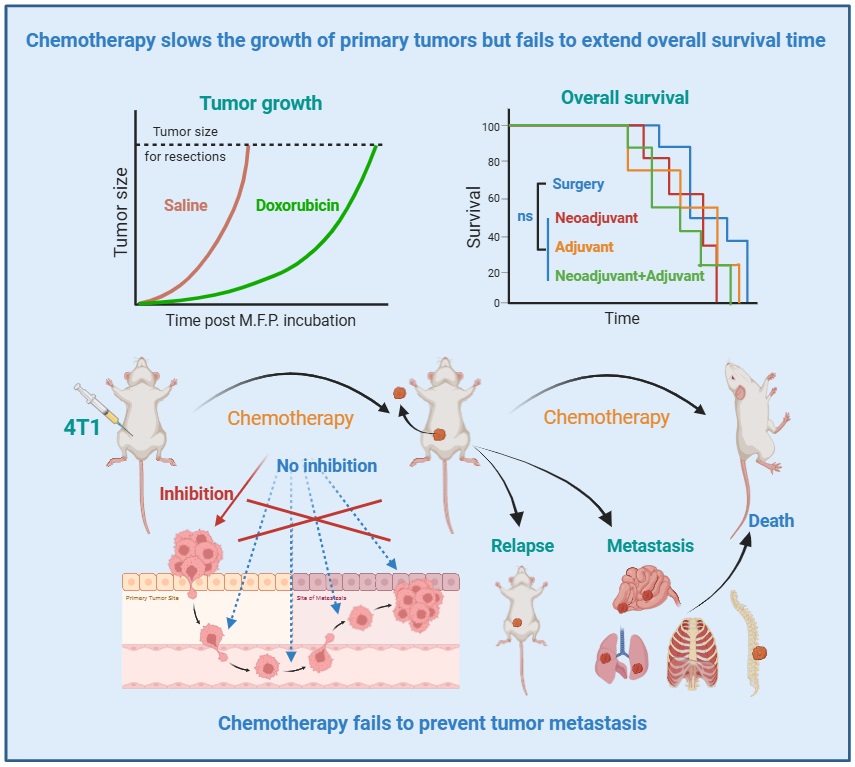
Abstract: Background: In preclinical research, tumor growth inhibition in subcutaneous models is frequently employed to evaluate therapeutic efficacy; however, such models often lack clinical translatability. Methods: To better approximate clinical reality, taking the case of doxorubicin treatment, we utilized an orthotopic transplant and resection (OtR) strategy to systematically assess the effects of neoadjuvant chemotherapy, adjuvant chemotherapy, and their combination on tumor growth, recurrence, and malignant progression. Results: Surprisingly, none of the treatments improved mouse survival, with adjuvant therapy even shortening it. Although neoadjuvant chemotherapy delayed preoperative tumor growth and all regimens reduced recurrence rates, none effectively prevented metastasis. Furthermore, all treatment groups exhibited weight loss, indicative of chemotherapy-induced cachexia. Conclusion: Collectively, these findings demonstrate that reduced tumor growth in preclinical mouse models does not necessarily translate into overall survival benefit. Our results emphasize the critical importance of prioritizing metastasis prevention over tumor growth inhibition as a key efficacy endpoint in antitumor drug evaluation.
(1) Li Xiaoxi; Luo Lingli; Qian Hui ; Improving the predictive accuracy of efficacy evaluation using tumor orthotopic transplant and resection model, Frontiers in Pharmacology, 2024, 15:1309876
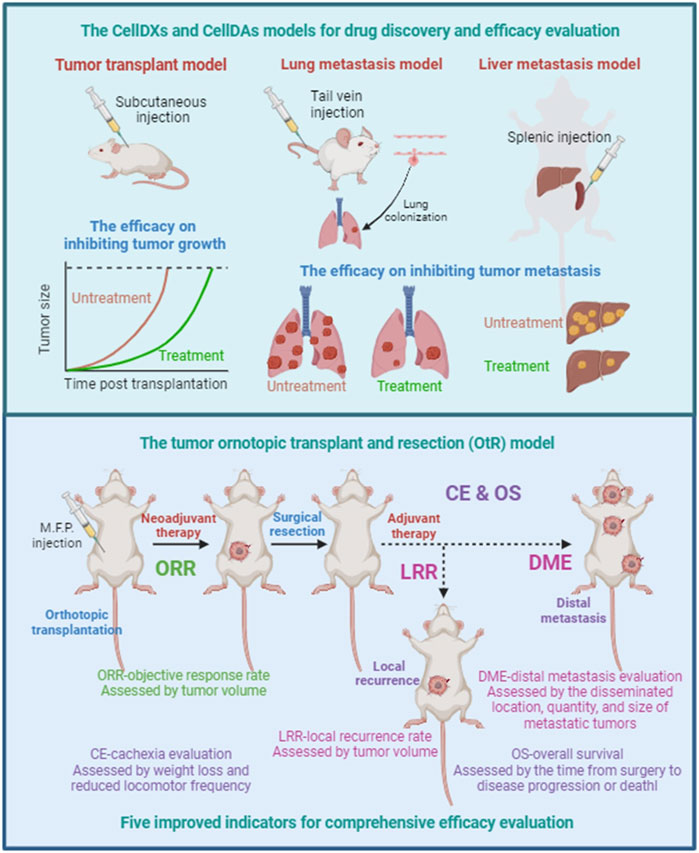
Abstract: Preclinical efficacy evaluation and tumor drug sensitivity analysis are two main applications of efficacy evaluation. Preclinical efficacy evaluation is to predict whether candidate drugs or therapies may improve patient outcomes in clinical trials. Tumor drug sensitivity analysis is an approach for the personalized evaluation and optimization of approved anti-cancer drugs and treatment regimens. Overall survival (OS) is the gold standard to evaluate the outcome of drugs or therapies in both clinical trials and clinical treatment. Many efficacy evaluation models, such as cell model, tumor cell-line transplant model, patient-derived tumor xenograft model, tumor organoid model, have been developed to assess the inhibitory effect of tested drugs or therapies on tumor growth. In fact, many treatments may also lead to malignant progression of tumors, such as chemotherapy, which can lead to metastasis. Therefore, tumor growth inhibition does not necessarily predict OS benefit. Whether it can prevent or inhibit tumor recurrence and metastasis is the key to whether drugs and therapies can improve patient outcomes. In this perspective, we summarize the current understanding of the pathological progression of tumor recurrence and metastasis, point out the shortcomings of existing tumor transplant models for simulating the clinical scenario of malignant progression of tumors, and propose five improved indicators for comprehensive efficacy evaluation to predict OS benefit using tumor orthotopic transplant and resection model. Improvement in the accuracy of efficacy evaluation will accelerate the development process of anti-cancer drugs or therapies, optimize treatment regimens to improve OS benefit, and reduce drug development and cancer treatment costs.